
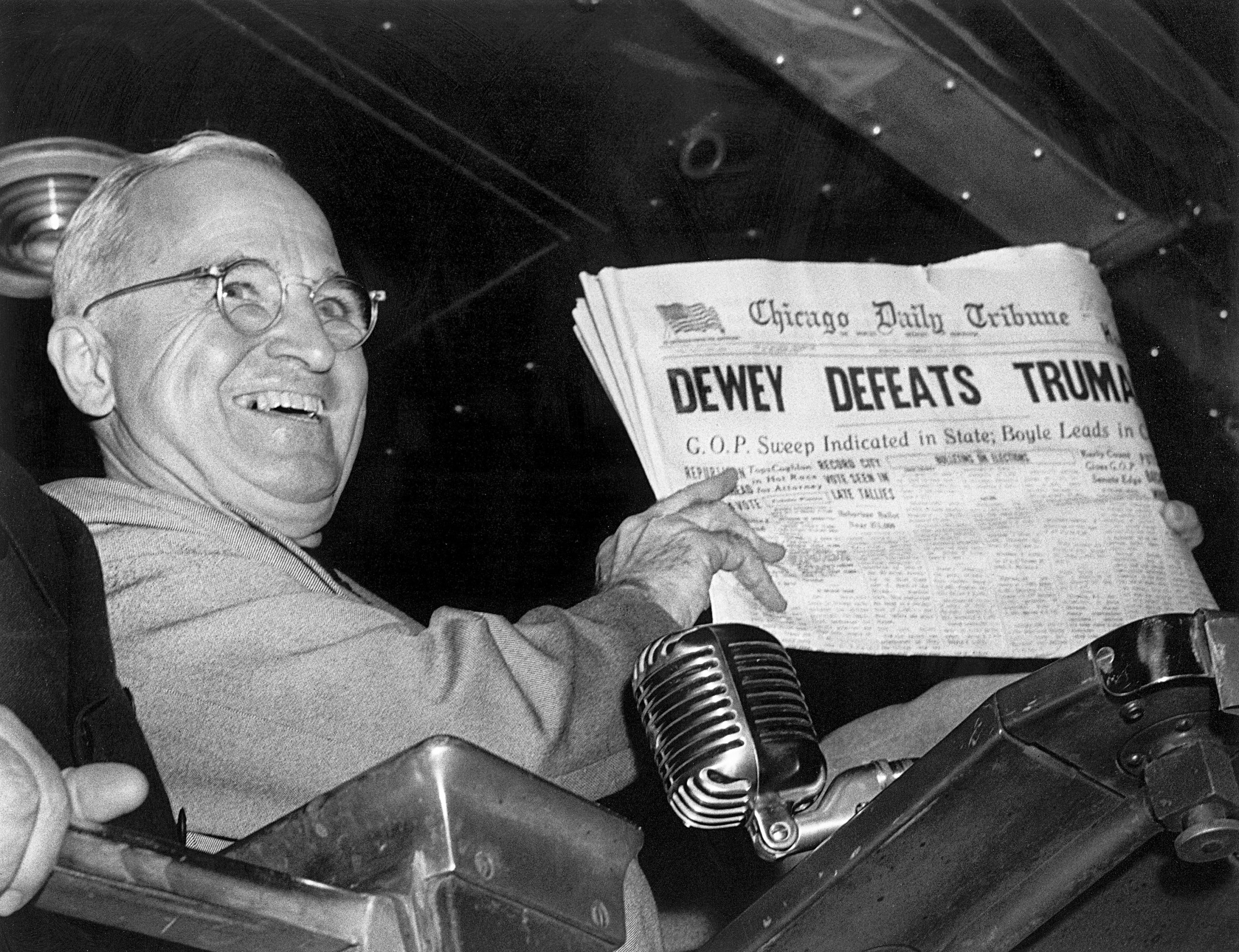
The 1948 presidential election proved to be one of the most contested elections in US history. President Harry Truman was running as the incumbent Democratic candidate. His platform was progressive. It focused on social and civil rights issues, including desegregation, voting rights, and equal employment opportunities.
Southern democrats were incensed by the idea of equality for black Americans. They broke away from the party, after the Democrat Convention, to form a separate offshoot branch of the Democratic Party. Officially named the States Rights Party, they were more commonly knowns as the Dixiecrats. They selected Strom Thurmond, the governor of South Carolina, as their candidate. Officially, they ran on a platform of state’s rights and limited federal government, however, that was a thinly vailed façade for segregation. The Dixiecrats were desperate to maintain the Jim Crow laws which had benefited them for well over half a century, since the end of Reconstruction.
Poised against the backdrop of party division, Thomas Dewey seemed a failsafe bet to bring the Republican Party back to the White House. Their platform of reducing wasteful spending, balancing the budget, and maintaining a strong national defense resonated with many voters.
Pollsters, throughout the country, pointed to a landslide victory for Dewey. Truman was unpopular and lacked the oratory flair of FDR. Thurmond was guaranteed to win the southern states. At best, Truman could hope for a tie. In no scenario was Truman predicted to be the winner. However, the pollsters hadn’t accounted for all the voters, nor had they considered motivating factors outside of the typical soundbites of economy and national defense.
To truly understand the shift that was taking place in America, one must step back a few years and look at the demographics for black Americans and how that could impact upcoming Presidential races. According to the US Census Bureau, in 1940 there were approximately 9.9 million black Americans living in the southern United States. They lived under harsh Jim Crow laws, which suppressed upward economic mobility, land ownership, and voting rights. Given that the total U.S. black population was 12.8 million, it’s easy to see why pollsters didn’t actively consider the black vote at that time. Over two thirds of the black population lived under voter suppression.
In June of 1941, with Europe engulfed in the Second World War, President Franklin D. Roosevelt signed Executive Order 8802 which prohibited racial and ethnic discrimination in the nation’s defense industry. The order included private contractors, government agencies, and unions. Shortly thereafter, the government established the Fair Employment Practice Committee, or FEPC for short. The idea was straightforward. U.S. involvement in the war was inevitable. The country would need manpower to supply critical components to the war machine. The FEPC helped to ensure that blacks and minorities could gain meaningful employment in skilled positions in defense factories without fear of discrimination. When the U.S. entered the war in December of 1941, the FEPC played an important role in war effort at home.
Thus, began what can be called the second phase of the Great Migration. Black Americans began to move out of the Jim Crow south for greater economic opportunity in the north. By 1950, it was estimated that 1.5 million black Americans had fled up north or out west. In one decade, approximately twelve percent of black Americans moved to areas of the country where their right to vote was protected.
Simultaneously, black men and women were volunteering to serve in all branches of the military. All black units were formed and sent to both the European and Pacific Theaters. Unfortunately, many of these units were relegated to support services within the military. These men and women had to fight racism and stereotyping in the military to earn the opportunity to fight for their country.
To make matters worse for black servicemembers, they were often sent to training facilities in the deep south. Local communities afforded them no greater protection than any other person of color. These servicemembers faced discrimination, harassment, and physical assault on numerous occasions when out in public.
During this time, the Double V Campaign was born. Black communities across the country saw the war as a battle to defeat fascism in Europe and racism here at home. They began to organize. The NAACP and other community leaders lobbied the US government to declare war on racism.
Upon their return home after the war, black servicemembers were largely ignored or forgotten. There were no tickertape parades awaiting them. They were not given the hero’s welcome that white servicemembers received. They would not, however, go quietly into the night. They were not willing to continue with the status quo. They demanded civil rights reform and equal protection under the law.
Pressure continued to mount. In December 1946, President Truman signed Executive Order 9808 to create the President’s Committee on Civil Rights. The committee was charged with researching and documenting the conditions of civil rights here in the United States. One year later, the committee returned with a 178 page report. In this document they recommended a Congressional Commission on Civil Rights, as well as a Civil Rights Division within the Department of Justice. The report also suggested that the federal government end the poll tax used in many states to limit voter participation, create federal protections from lynching, and the FEPC permanent.
These recommendations came at a somewhat precarious time for Truman. He was seeking reelection as a less-than-popular candidate. For the next six months, he faced uphill battles within his own party, as well as political opposition from the rival Republican Party. In July 1948, less than four months before the Presidential election, the Dixiecrats officially broke with the Democratic Party and began a third-party campaign.
Officials from the Truman campaign met with black leaders and civil rights organizers. They believed that black voters could help tip the scales in Truman’s favor. To be sure, this was a risk. The 1940 census was prior to the second black migration north. There would be no way to know how many newly registered black voters there were until the next census in 1950, two years after the election.
Black leaders made it clear that the time for promises was long passed. The black community would need tangible action to support a candidate en masse. On July 26, 1948, President Truman signed Executive Orders 9980 and 9981. These two orders created fair employment practices within the federal government and desegregation the US Armed Forces. Federal agencies were no longer allowed to discriminate based on race, color, religion, or national origin. Likewise, the military was no longer allowed to be segregated based on color.
The next few months of campaigning were fierce. Pollsters calculated that Dewey would easily win over the other two candidates. Polls across America showed Dewey with a sizeable lead, except in the south where Thurmond held the lead. Truman’s campaign was spirited and energized, while Dewey favored a more conservative and measured approach. The former reinvigorated his voter base. The latter did not want to do anything to upset his lead.
On November 2, 1948, Americans went to the polls and cast they votes. Many black voters voted for the first time. When the results began to come in Dewey took an initial lead, but Truman soon overtook the lead never to relinquish it. Shortly before midnight, Dewey sent congratulations to President Truman.
Despite his lead during election night, some reporters were convinced that as the late returns came in, Dewey would still win. The Chicago Daily Tribune went so far as to go to press with that assumption. Truman took great delight in holding that paper in the now infamous photo.
While there are numerous factors that go into a successful presidential campaign, the election of 1948 is an important step forward in the civil rights struggle. Not only did minorities gain fair employment in the federal government and desegregate the military, but it also marked the first time in US history that a national campaign actively sought the black vote and it marked the first time in US history that the black voting block successfully impacted the outcome of the election.

Still to this day I enjoy reading every post that is uploaded on here. I would not have been able to learn about the development, flourishment and the destruction of the city of Atlanta thoroughly if it wasn’t for you doing this. I lived in Atlanta for 11 years and grew up in Georgia and wasn’t taught about this important part of history in the city I call home. Thanks for doing these and looking forward to more.